
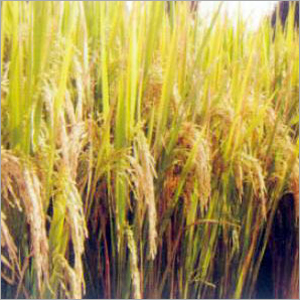
Shubhangi Paddy Seeds
200 INR/Pack
Product Details:
- Product Type Paddy Seeds
- Type Spices Seeds
- Cultivation Type Common
- Grade A
- Variety Shubhangi
- Weight 1 Kg
- Color White
- Click to View more
X
Shubhangi Paddy Seeds Price And Quantity
- 200 INR/Pack
- 10 Pack
- Non-GMO
Shubhangi Paddy Seeds Product Specifications
- Paddy Seeds
- 1 Kg
- 0.8%
- 2%
- White
- A
- 12 Months
- 98%
- 1%
- Spices Seeds
- Common
- 12%
- Sun Dry
- Shubhangi
- No
- Yes
Shubhangi Paddy Seeds Trade Information
- 1 Pack Per Week
- 1 Week
Product Description
Paddy Seeds (Shubhangi)
| Days to 50% Flowering | 100-105 days |
| Days to maturity | 130-135 days (seed to seed) |
| Plant height(cm) | 110-120 |
| No. of tillers/plant | 23-25 |
| Leaf colour | Very dark Green |
| Anther colour | Yellow |
| Panicle length (cm) | 24-26 |
| Panicle shape | Compact, semi drooping |
| J No. of branches/panicle | 16-18 |
| I No. of seeds/panicle | 300-320 |
| Seed Width. (mm) | 1.3-1.5 |
| Seed length (mm) | 6 7 |
| 1000 seed weight (g) | 12/14/12 |
| Grain quality | Fine |
| Disease resistance | Tolerant to major leaf diseases |
| Response to lodging | Tolerant |
| Response to shattering | Tolerant |
Exceptional Yield and Disease Resistance
Shubhangi Paddy Seeds are recognized for their impressive germination rate and strong resistance to common paddy diseases. This ensures that farmers can anticipate healthy crops with reduced losses caused by plant diseases. Their natural robustness decreases the need for excessive chemical interventions, further supporting sustainable farming practices and maintaining yield consistency.
Best Practices for Storage and Sowing
To maximize the seeds viability, store them in a cool and dry location. Proper storage discourages mold growth and maintains the seeds 98% purity and 85% germination rate. For sowing, prepare the field carefully and use the recommended agricultural practices to achieve optimal growth. Regular monitoring during the 110120 day maturity period is advised for best results.
Quality Standards and Assurance
Produced under expert supervision, Shubhangi Paddy Seeds boast Grade A quality, minimal admixture (2%), and a low imperfect ratio (1%). Rigorous sun-drying and quality control measures ensure consistent performance from sowing to harvest. As an exporter, manufacturer, and supplier in India, consistent quality is prioritized to deliver reliable agricultural solutions.
FAQs of Shubhangi Paddy Seeds:
Q: How should Shubhangi Paddy Seeds be stored to maintain their quality?
A: Shubhangi Paddy Seeds should be kept in a cool and dry place. Proper storage conditions help preserve the seeds germination rate and purity, and extend their shelf life up to 12 months.Q: What is the recommended sowing process for Shubhangi Paddy Seeds?
A: Prepare the field by ensuring proper tillage and moisture content. Sow the seeds at optimal spacing and depth as suited for paddy cultivation. Regularly monitor water levels and protect the field from weeds for best results.Q: When is the ideal time to harvest crops grown from Shubhangi Paddy Seeds?
A: Rice grown from Shubhangi Paddy Seeds is typically ready for harvest within 110120 days after sowing, depending on local environmental conditions and agricultural practices.Q: Where are Shubhangi Paddy Seeds manufactured and supplied from?
A: These seeds are manufactured, exported, and supplied by reputable companies in India, ensuring they meet national and export quality standards.Q: What makes Shubhangi Paddy Seeds beneficial for agriculture?
A: They offer a high germination rate of 85%, 98% purity, and strong resistance to common diseases, resulting in healthy crops with consistent yields. Their Grade A quality further supports productive farming.Q: How can farmers ensure maximum germination from these seeds?
A: Using fresh seeds within the 12-month shelf life and following recommended storage and sowing practices will support optimal germination and growth.Q: What distinguishes Shubhangi Paddy Seeds from hybrid varieties?
A: Shubhangi Paddy Seeds are non-hybrid, known as common-type seeds, offering reliable characteristics that can be saved from season to season, unlike many hybrids which require fresh purchase every cycle.Tell us about your requirement

Price:
Quantity
Select Unit
- 50
- 100
- 200
- 250
- 500
- 1000+
Additional detail
Mobile number
Email

Other Products in 'Paddy Seeds' category


WE PRODUCE SEEDS ONLY FOR SOWING/PLANTING PURPOSE
Contact Us
SAFAL SEEDS AND BIOTECH LTD.
GST : 27AAFCS2536M1Z1
GST : 27AAFCS2536M1Z1

- Post Box No. 39, A-2, Old MIDC Industrial Area, Jalna - 431203, Maharashtra, India
- Phone : 08045477817

- Mr Kamal Zunzunwala (Managing Director)
- Mobile : 08045477817
-
 Send Inquiry
 Send Inquiry
|

SAFAL SEEDS AND BIOTECH LTD.
All Rights Reserved.(Terms of Use)
Developed and Managed by Infocom Network Private Limited.
Developed and Managed by Infocom Network Private Limited.

